
 How a monk and a mallet changed the world
by
Mention history and some might struggle to stifle a yawn. But when presented as a narrative it can often be compelling reading. Stephen J. Nichols takes a key period in time, the Reformation, and presents its major players in a fresh way. From Martin Luther, a simple monk who wielded the mallet, to kings and queens, this book goes behind the scenes to uncover the human side of these larger-than-life Reformers. Along the way readers meet Luther, Ulrich Zwingli, John Calvin, Kings Henry VIII and Edward VI, Lady Jane Grey, Anne Bradstreet, and many others. For those wanting to see history in its context, Nichols also provides a sampling of primary source materials. It is an engaging read that will remind readers of the foundational truths that can never be taken for granted by the church in any age. Includes numerous illustrations.
How a monk and a mallet changed the world
by
Mention history and some might struggle to stifle a yawn. But when presented as a narrative it can often be compelling reading. Stephen J. Nichols takes a key period in time, the Reformation, and presents its major players in a fresh way. From Martin Luther, a simple monk who wielded the mallet, to kings and queens, this book goes behind the scenes to uncover the human side of these larger-than-life Reformers. Along the way readers meet Luther, Ulrich Zwingli, John Calvin, Kings Henry VIII and Edward VI, Lady Jane Grey, Anne Bradstreet, and many others. For those wanting to see history in its context, Nichols also provides a sampling of primary source materials. It is an engaging read that will remind readers of the foundational truths that can never be taken for granted by the church in any age. Includes numerous illustrations.


Trinity Grammar Libguide - Luther and the Reformation
 Inside the Reformation
by
Inside the Reformation is a visual journey through the Reformation with concise text and richly designed pages. While not laid out as a traditional history book, it communicates the same information through pictures, illustrations, and short articles in a fun way. This book makes a great addition to school libraries, classrooms, and personal collections.
Inside the Reformation
by
Inside the Reformation is a visual journey through the Reformation with concise text and richly designed pages. While not laid out as a traditional history book, it communicates the same information through pictures, illustrations, and short articles in a fun way. This book makes a great addition to school libraries, classrooms, and personal collections.
 Luther - a guide for the perplexed
by
"Martin Luther is for the most part fascinating, sometimes annoying, and for many people perplexing: Whitford provides an insight to the reformer's biographical context, his theological foundations and primarily his political theory.
Luther - a guide for the perplexed
by
"Martin Luther is for the most part fascinating, sometimes annoying, and for many people perplexing: Whitford provides an insight to the reformer's biographical context, his theological foundations and primarily his political theory.
 Luther Gold
by
Luther wrote, Faith is a living, daring confidence in God's grace, so sure and certain that a man could stake his life on it a thousand times. Ray Comfort has gleaned glistening gold from the writings of this great man of God, who changed the course of Western civilization through the Protestant Reformation. He shows how Luther's thoughts and writings continue to show forth the need for evangelism in our present day. Martin Luther taught that salvation is a free gift of God that is not based on works. It can only be received by grace through faith in Jesus. (See Ephesians 2:8-9.) This same message is what people need to hear today.
Luther Gold
by
Luther wrote, Faith is a living, daring confidence in God's grace, so sure and certain that a man could stake his life on it a thousand times. Ray Comfort has gleaned glistening gold from the writings of this great man of God, who changed the course of Western civilization through the Protestant Reformation. He shows how Luther's thoughts and writings continue to show forth the need for evangelism in our present day. Martin Luther taught that salvation is a free gift of God that is not based on works. It can only be received by grace through faith in Jesus. (See Ephesians 2:8-9.) This same message is what people need to hear today.
 Martin Luther - A concise history of his life and works
by
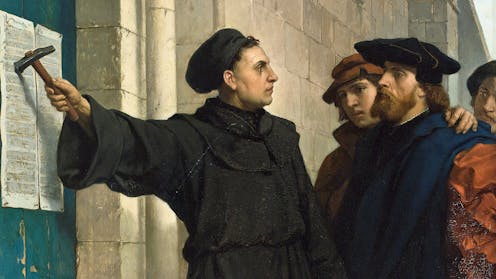
Martin Luther was so angered by the sale of indulgences (pardons for sins granted by the Pope) that, in 1517, he nailed 95 arguments for reform of the Roman Catholic Church to the doors of the church and the castle at Wittenberg. This act began one of the most momentous periods of change in history: the Reformation. So much has been written on Luther that it's difficult for a beginner to know where to start. This book is an introduction, succinct and readable, but substantial and not skimpy. It covers or summarizes Luther's major works and the main events of his life, and it invites the reader to meet him at his study desk, in the lecture hall, in the pulpit, at the dinner table.
Martin Luther - A concise history of his life and works
by
Martin Luther was so angered by the sale of indulgences (pardons for sins granted by the Pope) that, in 1517, he nailed 95 arguments for reform of the Roman Catholic Church to the doors of the church and the castle at Wittenberg. This act began one of the most momentous periods of change in history: the Reformation. So much has been written on Luther that it's difficult for a beginner to know where to start. This book is an introduction, succinct and readable, but substantial and not skimpy. It covers or summarizes Luther's major works and the main events of his life, and it invites the reader to meet him at his study desk, in the lecture hall, in the pulpit, at the dinner table.
 Martin Luther - The Cambridge Companion
by
Martin Luther (1483–1546) stands as one of the giant figures in history. His activities, writings, and legacy have had a huge effect on the western world. This Cambridge Companion provides an accessible introduction to Martin Luther for students of theology and history and for others interested in the life, work and thought of the first great Protestant reformer. The book contains eighteen chapters by an international array of major Luther scholars. Historians and theologians join here to present a full picture of Luther's contexts, the major themes in his writings, and the ways in which his ideas spread and have continuing importance today. Each chapter serves as a guide to its topic and provides further reading for additional study. The Companion will assist those with little or no background in Luther studies, while teachers and Luther specialists will find this accessible volume an invaluable aid to their work.
Martin Luther - The Cambridge Companion
by
Martin Luther (1483–1546) stands as one of the giant figures in history. His activities, writings, and legacy have had a huge effect on the western world. This Cambridge Companion provides an accessible introduction to Martin Luther for students of theology and history and for others interested in the life, work and thought of the first great Protestant reformer. The book contains eighteen chapters by an international array of major Luther scholars. Historians and theologians join here to present a full picture of Luther's contexts, the major themes in his writings, and the ways in which his ideas spread and have continuing importance today. Each chapter serves as a guide to its topic and provides further reading for additional study. The Companion will assist those with little or no background in Luther studies, while teachers and Luther specialists will find this accessible volume an invaluable aid to their work.
 Martin Luther: Hero of the Reformation
by
Relates the story of Martin Luther's life, focussing particularly on his struggles with the Catholic church, and his influence on the reforms of the Christian world which followed.
Martin Luther: Hero of the Reformation
by
Relates the story of Martin Luther's life, focussing particularly on his struggles with the Catholic church, and his influence on the reforms of the Christian world which followed.
 Mrs Luther and Her Sisters
by
Women have made crucial contributions to the life of the Church from New Testament times onwards, but the Reformation saw an explosion in their involvement. Having benefited alongside their brothers from the Renaissance's emphasis on learning, and with the increasing casting aside of the belief that they were intellectually inferior, women learned to read in ever increasing numbers—and most of them wanted to read the Bible. As a result, many started to interpret Scripture for themselves, putting them on a collision course with the Church.
Mrs Luther and Her Sisters
by
Women have made crucial contributions to the life of the Church from New Testament times onwards, but the Reformation saw an explosion in their involvement. Having benefited alongside their brothers from the Renaissance's emphasis on learning, and with the increasing casting aside of the belief that they were intellectually inferior, women learned to read in ever increasing numbers—and most of them wanted to read the Bible. As a result, many started to interpret Scripture for themselves, putting them on a collision course with the Church.
 The Protestant Revolution
by
Early chapter of this book
Historian William Naphy asks how the actions of an obscure German monk are still shaping our modern world. When Martin Luther nailed 95 criticisms of the Catholic Church to the door of his local church in 1517, he sparked not just a religious reformation, but an unending cycle of political, social, and economic change that continues to this day. By challenging the authority of the Pope, Luther inadvertently unleashed a revolutionary force#151;the power of the individual to determine his or her own thoughts and actions. Naphy demonstrates hownbsp;more thannbsp;four centuries later, Protestant minister Martin Luther King, Jr. was acting on the same revolutionary principle when he rejected racial discrimination and spearheaded the civil rights movement. The legacy of the Reformation is all around us, influencing our work life, family life, sex life, and political views. From literature to science, from gay marriage to the "War on Terror," a vibrant struggle for Protestant principles is alive.
The Protestant Revolution
by
Early chapter of this book
Historian William Naphy asks how the actions of an obscure German monk are still shaping our modern world. When Martin Luther nailed 95 criticisms of the Catholic Church to the door of his local church in 1517, he sparked not just a religious reformation, but an unending cycle of political, social, and economic change that continues to this day. By challenging the authority of the Pope, Luther inadvertently unleashed a revolutionary force#151;the power of the individual to determine his or her own thoughts and actions. Naphy demonstrates hownbsp;more thannbsp;four centuries later, Protestant minister Martin Luther King, Jr. was acting on the same revolutionary principle when he rejected racial discrimination and spearheaded the civil rights movement. The legacy of the Reformation is all around us, influencing our work life, family life, sex life, and political views. From literature to science, from gay marriage to the "War on Terror," a vibrant struggle for Protestant principles is alive.
 When Lightning Struck!
by
A fast-paced, action-packed, easy read novel of Martin Luther's life, introduces a fascinating time when princes ruled Europe and knights roamed the countryside. Describes a time when powerful forces lined up against each other and believing the wrong thing could get you killed.
The book also tells a theological story drawing carefully from Luther's own words. It introduces a man who struggled with what knowing God through Scripture means for daily life. Readers will understand what was at stake and how powerfully liberating Luther's idea of grace through faith was in his time and in ours!
When Lightning Struck!
by
A fast-paced, action-packed, easy read novel of Martin Luther's life, introduces a fascinating time when princes ruled Europe and knights roamed the countryside. Describes a time when powerful forces lined up against each other and believing the wrong thing could get you killed.
The book also tells a theological story drawing carefully from Luther's own words. It introduces a man who struggled with what knowing God through Scripture means for daily life. Readers will understand what was at stake and how powerfully liberating Luther's idea of grace through faith was in his time and in ours!